Moderation clear to creators, faster for teams
Building an account health and user warnings system for creators, compliance, and trust at scale.


Where this sat inside Fanvue.
Fanvue is a creator economy platform headquartered in London: paid exclusive content, AI-powered creator tools, and a rapidly growing compliance surface.
A moderation system that worked against everyone.
Creators learned about violations through a generic email, sometimes with a “Strike” attached. No dashboard. No context. No self-service. The result was predictable:
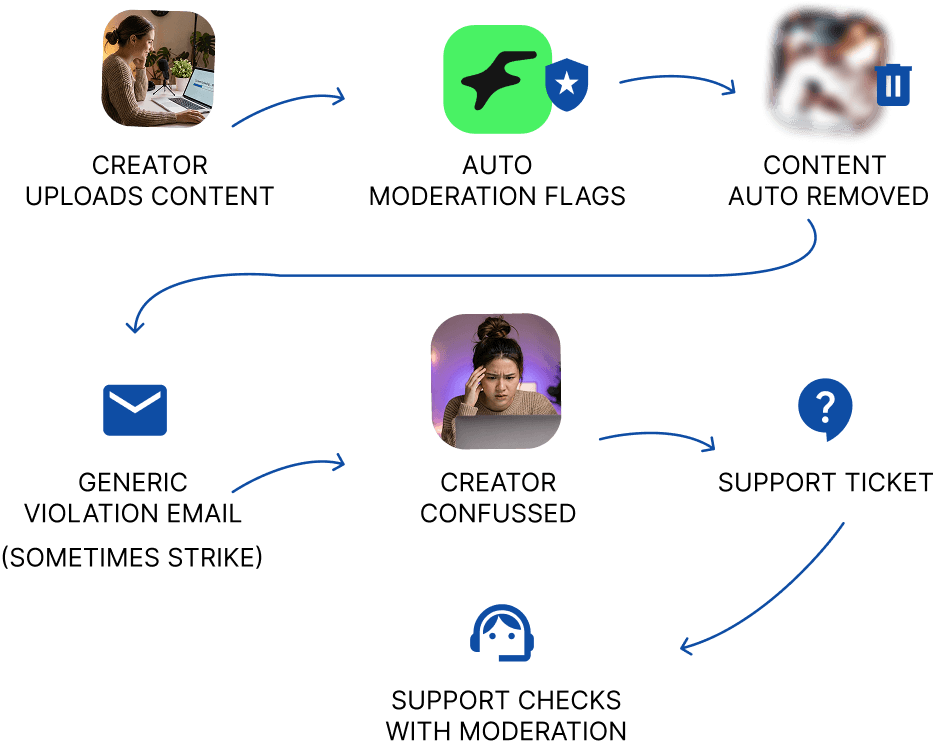
- Missed or disputed warnings: the most common support trigger
- Repeated violations because creators never understood the rule
- Support acting as a permanent translator between creators and moderators
Why the Strike system failed at scale
38 violation types, one model. No severity, no escalation, no explanation. Creators couldn’t tell if a strike was a warning or a step toward a ban.
Policy changes made it urgent
New regulations on copyright, AI-generated content, deepfakes, and underage content demanded more nuance than a single strike could express.
A unified source of truth for creators, moderators, and support.
The goal was a system where what happened internally was always reflected consistently in what creators saw. That required designing three things in parallel.
Account Health dashboard
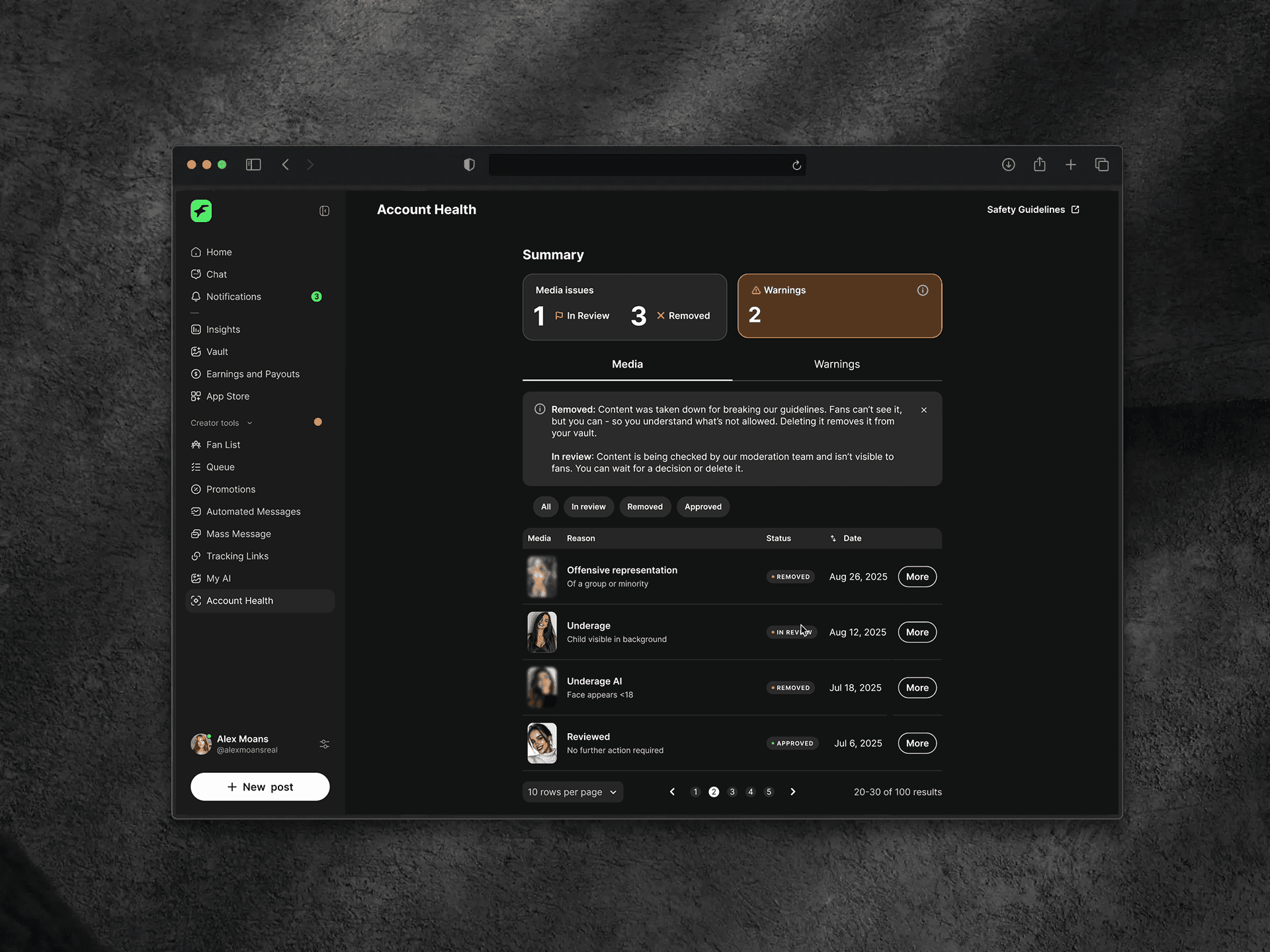
A single view showing overall account status, active warnings, severity level, escalation risk, and a plain-language explanation of any action taken. Accessible from the homepage, notifications, profile page, vault, and email.
User Warnings (replacing Strikes)
Each warning shows the creator what happened and when, with the reason and where to get help. Severe or repeated warnings lead to a ban. Internal moderator notes (fraud, AML, legal context) are kept separate.

Clear content status at every stage
Three states: In Review, Removed, Approved, each with a plain-language explanation. Creators can self-delete removed content from the vault without contacting support.

Two models work together. Severity is the policy: four levels, from informational (Level 1) to zero tolerance (Level 4). The path is what the creator sees: at the third warning, access is removed and the creator gets an email. Severity then decides the outcome: Restricted, where the creator can talk to support and moderation and good faith is reviewed, or Banned, with no discussion possible.
Every violation is recorded twice. One record is for the creator. The other stays internal to moderation and support. The split is what made graduated transparency possible: creators get clarity, legal and investigative context stay protected.
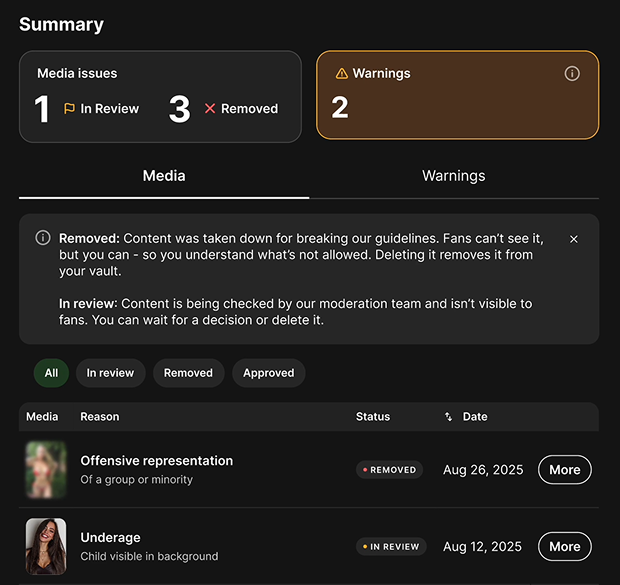
Surfacing issues where creators already are.
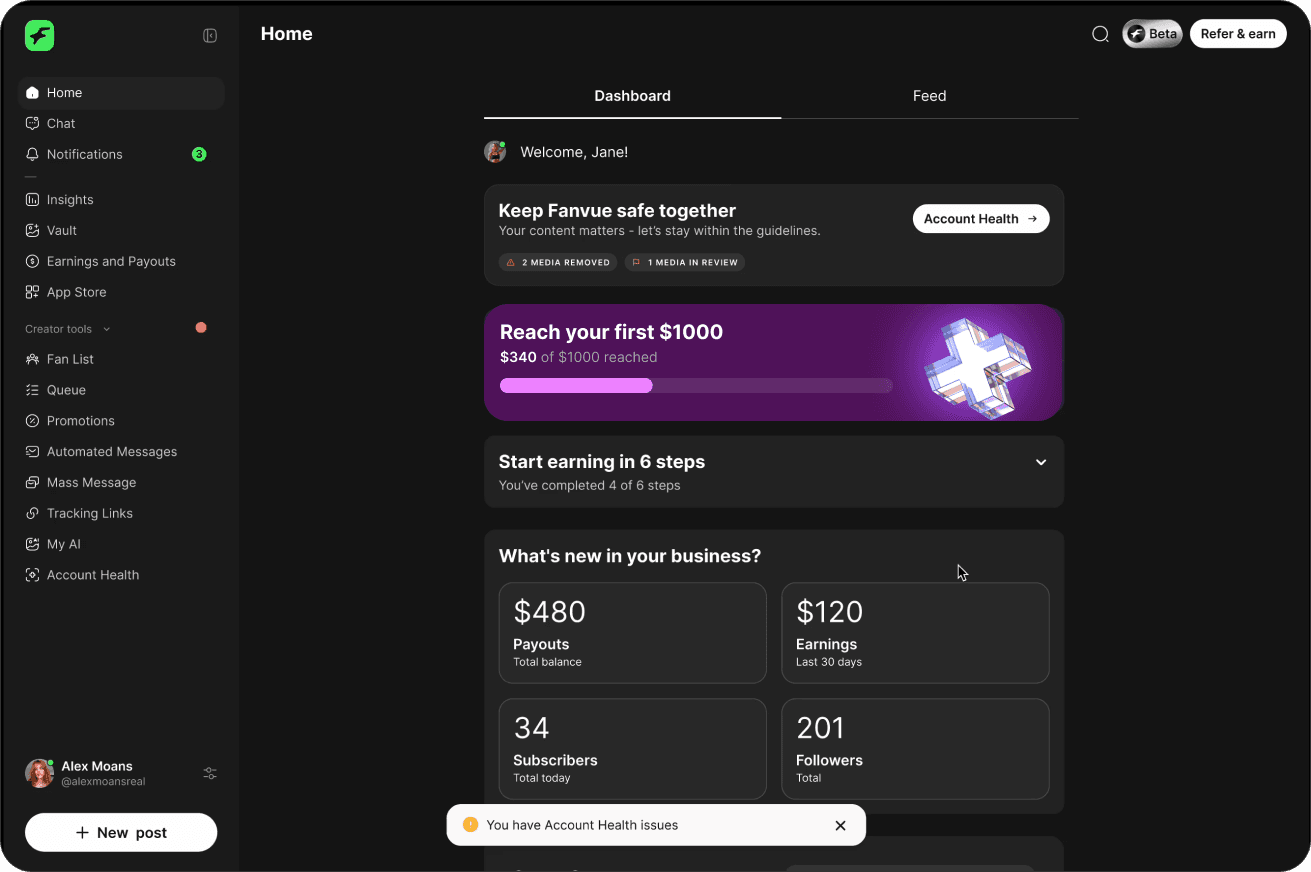
Violations surface through five touchpoints: homepage banner, notifications, profile page, vault, and email. Creators never have to go hunting for their account status.

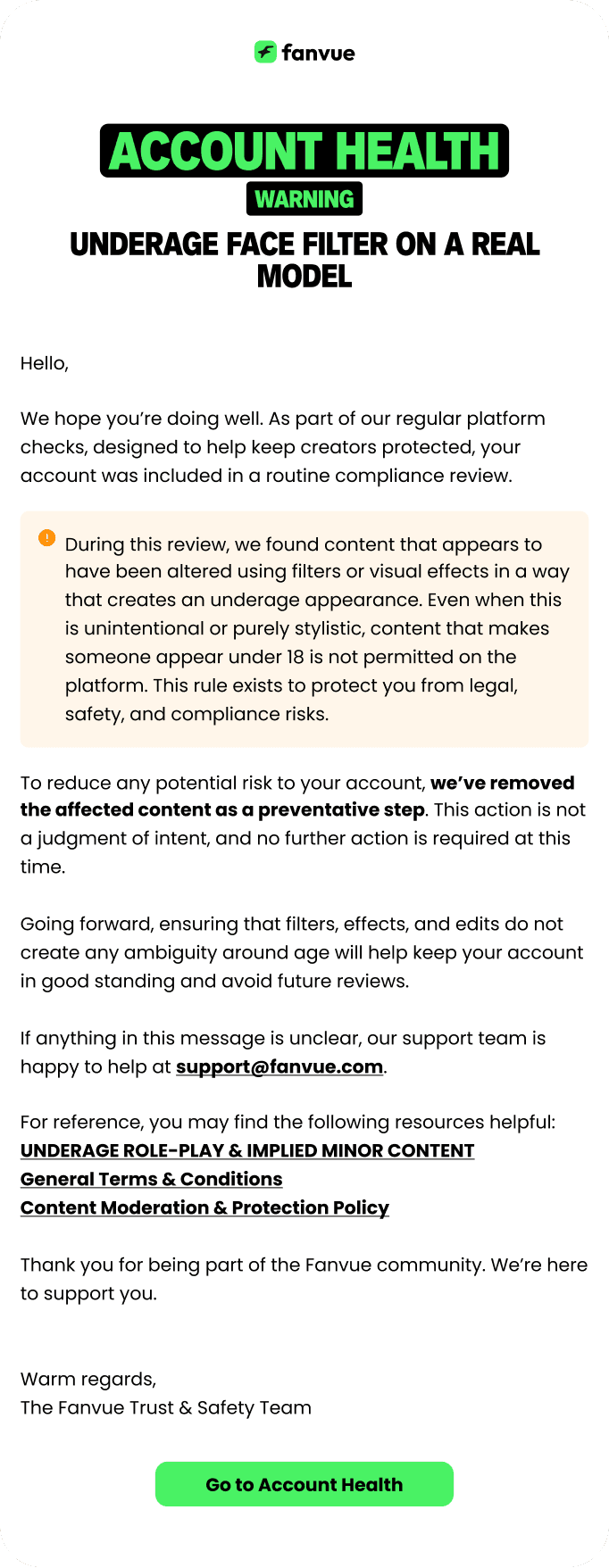
Clear emails, per violation type.
Templates were created for each violation type. Every email says what was found in plain language, why the rule exists, and the action taken, framed as prevention rather than judgment. It ends with what to do next, links to the relevant policies, and a button back to Account Health. The tone is firm but supportive: warning without drama.
From punishment to prevention.
Policy guidance is embedded contextually throughout the experience: not buried in a help centre. Every violation surfaces why the content was flagged, which rule applies, and what to do differently next time.

Getting moderation, support, and compliance onto the same page.
Before this project, moderation actions, internal notes, and creator communications lived in separate systems. Account Health gave all three teams a shared view, eliminating the need for support to act as a middleman on every complaint.
Moderators log User Warnings (creator-visible) and Admin Notes (internal only, for investigations, fraud, AML, legal).
Support accesses full context directly from Account Health. No more back-and-forth with the moderation team.
Three trade-offs that shaped the outcome.
This project required making deliberate trade-offs between transparency, compliance, and operational scalability.
Warnings instead of Strikes
"Strike" reads as opaque and punitive. Warnings allow for graduated escalation, carry educational weight, and make ban thresholds legible to creators.
Separate User Warnings and Admin Notes
Legal and investigative context shouldn't be user-visible. Transparency must be controlled and intentional: not a liability.
A centralised view over inline indicators
Inline flags on content create noise without context. Creators needed to see patterns across their account, not isolated incidents.

Learnings
“Moderation is not an edge case. It is a core product system.”
“Transparency reduces conflict more effectively than enforcement alone.”
“UX must sometimes prioritise legal clarity over simplicity.”
“Designing for scale means designing for org alignment, not just users.”
From friction to conversion, one test at a time
Go to case study →